Jev: the AI that doesn’t talk – it decides
With Jev, TypeSafe AI has introduced a model that writes no text but makes decisions – in milliseconds and with a stated level of uncertainty. What lies behind it, where it works for small and mid-sized businesses, and where it doesn’t.
Monday, 8:12 a.m. A trade business’s inbox holds 140 new messages: quote requests, complaints, invoices, a job application, three newsletters. Every one of them demands a decision – where does it go, how urgent is it, who takes care of it? None of them demands a conversation.
This is exactly the gap a model that emerged in mid-September 2026 aims to fill. It is called Jev, comes from the US start-up TypeSafe AI and has a property that is unusual in today’s AI landscape: it cannot chat. It writes no paragraphs, summarises nothing and does not explain itself. It answers a question defined in advance – and tells you how certain it is.
Behind TypeSafe is Diogo Almeida, co-author of the 2022 InstructGPT paper, which heise describes as an important foundation of ChatGPT. The company was founded in 2024, has raised 40 million US dollars in seed funding according to heise, and has offered Jev in early access through a hosted API since September 2026. Anyone who wants to understand where automation in small and mid-sized businesses is heading should take a closer look at this model – with curiosity, but also with the necessary distance.
Two ways of thinking
The name of the model class is no accident. TypeSafe calls Jev a “System One model”, borrowing an image from the psychologist and Nobel laureate Daniel Kahneman. In “Thinking, Fast and Slow” (2011) he distinguishes two modes of thought: System 1 is fast, automatic and effortless – it recognises an angry face before we consciously look. System 2 is slow, effortful and deliberate – it works out 17 × 24 or weighs up a contract.
In this metaphor, large language models resemble System 2: they “think out loud”, generating an answer token by token, and can argue, write and program along the way. That is powerful – and simply oversized for many everyday decisions. If all you want to know is whether an email is a complaint, you don’t need an essay about it. Jev is an attempt to build the fast, intuitive judgement as a product of its own.
What Jev is – and what it isn’t
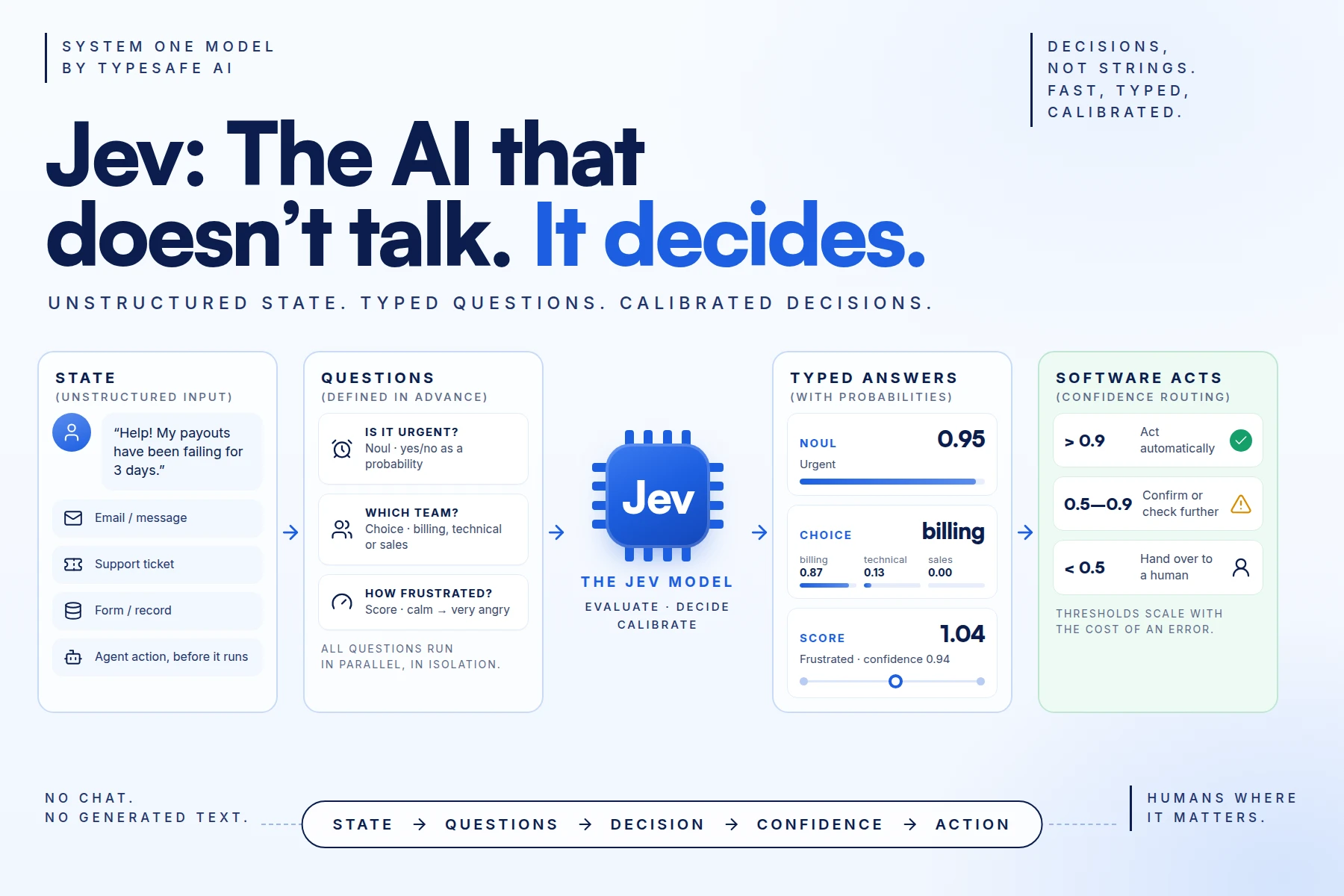
Technically, Jev takes two things: a state – such as the text of a customer enquiry, a ticket or a record – and one or more questions about it. You define the possible answers in advance. What comes back is not prose but a typed result that software can process directly. The documentation knows three basic forms:
- Noul – a yes/no statement, answered as a probability between 0 and 1 (“Is this message urgent?”).
- Choice – a pick from a fixed list, with a probability per option (“Sales, technical or accounting?”).
- Score – a rating on a scale you define yourself (“calm – frustrated – very angry”).
With every answer Jev returns a confidence: a number between 0 and 1 derived from the probability distribution. If the distribution is concentrated on one option, the model is certain; if it is spread out, it is uncertain. According to TypeSafe, this behaviour was trained with a method of its own called “Reinforcement Learning for Calibrated Decisions” (RLCD). The idea: it rewards not only the right decision but also an honest estimate of one’s own certainty.
All questions about a state are evaluated in parallel and independently of one another. According to LangChain, an additional question therefore barely changes the response time – ten assessments of one email take hardly longer than one.
What Jev is not matters just as much: not a chatbot, not a text generator, not a replacement for a language model. Its own documentation says so plainly – the model is not trained to generate text and performs poorly when forced to.
The numbers – and who measured them
- 70–500 msResponse time per requestper the vendor, depending on use
- $0.042per 1M input tokensoutput is free
- 32,000token context windowmodel version jev-1.13.0
- 3answer typesNoul, Choice, Score
On its own website, TypeSafe advertises in superlatives: on System One tasks, Jev is said to be 193.6 times faster and 444.6 times cheaper than a language model, answering in 0.114 instead of 8.566 seconds. Numbers like these are impressive – and call for a second look.
Because the vendor measured them itself, as heise explicitly points out. According to heise, the reference for “correct” answers was the average of the answers of two large language models, GPT-6 Astra and Claude Fable 5.1. KDnuggets adds that the 68 per cent accuracy TypeSafe cites also rests on such reference answers rather than independently verified ground truth. In other words: Jev was measured by how well it imitates large models – not by how often it is right in your business.
That doesn’t make the numbers worthless. It is plausible that a specialised model is orders of magnitude faster and cheaper than a generalist on a narrowly defined task. But no data sheet can tell you whether it is good enough for your decisions. Only your own data can.
What a decision looks like
An example from the documentation of Cloudflare, where Jev is available as a model on the Workers AI platform, shows the principle. A customer writes: “Help! My payouts have been failing for 3 days.” The software asks three questions about it at once:
const response = await env.AI.run("typesafe/jev", {
  state: "Help! My payouts have been failing for 3 days.",
  questions: {
    is_urgent: {
      type: "noul",
      instructions: "Does this convey urgency?",
      criteria: { true: "Explicitly time-sensitive", false: "No urgency expressed" },
    },
    department: {
      type: "choice",
      instructions: "Which team should handle this?",
      criteria: {
        billing: "Payments, invoicing, refunds",
        technical: "Bugs, outages, integrations",
        sales: "Pricing, upgrades, new accounts",
      },
    },
    frustration: {
      type: "score",
      instructions: "How frustrated is the customer?",
      criteria: ["Calm", "Frustrated", "Very angry"],
    },
  },
});

// Response (abridged):
// is_urgent   → noul: 0.95
// department  → choice: "billing", confidence: 0.8
//               probabilities: { billing: 0.87, technical: 0.13, sales: 0 }
// frustration → score: 1.04 ("Frustrated"), confidence: 0.94
The result is not prose but a data structure: urgent at 95 per cent, billing at 87 per cent, frustrated with high confidence. A program can react to it immediately – prioritise the ticket, assign it to the right team, alert a manager if needed.
Confidence is where it gets interesting. TypeSafe recommends three zones: above 0.9, the software may act automatically. Between 0.5 and 0.9, caution is called for, for example a confirmation or an additional check. Below 0.5, it should not act at all but hand over to a human or another system. More important than the exact values is the principle behind them: the threshold depends on the damage a mistake would do. A newsletter may be filed away with less certainty than a cancellation.
Where it works for SMEs
Jev plays to its strengths where three conditions meet: the decision recurs often, the possible answers can be listed in advance, and a single mistake can be corrected. For small and mid-sized businesses, this points to some obvious use cases:
- Sorting the inbox: enquiry, complaint, invoice, application or advertising – and how urgent?
- Pre-qualifying enquiries: does the project fit your services, and which budget band does it fall into?
- Routing support tickets: to technical, sales or accounting, with a priority.
- Analysing reviews and feedback: sentiment, topic, need for action.
- Guardrails for AI assistants: before a language model carries out an action, Jev checks whether it is risky – a pattern LangChain describes.
The last point in particular shows where things are heading. Jev is less a competitor than an accomplice of large language models. LangChain describes the division of labour like this: a language model for open-ended reasoning and writing, Jev for the fast, structured decisions in between. A customer service assistant could thus use Jev to settle who is responsible and how urgent it is – and only let a more expensive model draft a reply when one is actually needed.
Where it doesn’t work
TypeSafe is remarkably open about the weaknesses. Under the heading “model jaggedness”, the vendor itself documents where Jev 1.13 becomes unreliable:
- Arithmetic and counting – the model is explicitly “not a calculator”.
- Date and time logic – dates are read as text, not as ordered quantities.
- Nested logic such as double negatives or multi-step inferences.
- Lots of irrelevant context, which lowers accuracy.
- Manipulated input that steers the judgement through injected instructions.
- Contradictions between instructions and criteria, and reading literally rather than for intent.
Then there is a misunderstanding that KDnuggets puts in a nutshell. TypeSafe promises “zero hallucinations” – and that is only true in a narrow sense: Jev cannot invent an answer outside the options it was given. Within those options, however, it can very well be wrong.
Zero out-of-schema outputs, not zero incorrect decisions.
And finally, transparency: Jev does not give reasons for its decisions, and heise sees this as an open question. For your business, this means: if a customer wants to know why their request was deprioritised, the model offers no explanation. Your processes have to provide it.
No data sheet replaces your own measurement. Before Jev makes decisions in your business, put 100 to 200 real cases judged by humans to the test – only then will you know which confidence threshold holds for which action.
The law: whoever lets it decide remains responsible
In Europe, a model that decides touches two sets of rules. The first is the GDPR. Article 22 gives people the right not to be subject to a decision based solely on automated processing that produces legal effects concerning them or similarly significantly affects them. How far this reaches was shown by the Court of Justice of the European Union in its SCHUFA judgment of December 2023 (C-634/21): even an automatically calculated score can be such a decision if it plays a decisive role in the outcome.
In practice, this means: pre-sorting an email is unproblematic. Automatically rejecting a job application, or refusing a customer terms based solely on a model’s score, is not. A human belongs in that decision – one who genuinely reviews the result rather than just rubber-stamping it.
The second set of rules is the EU Artificial Intelligence Act. It classifies certain uses as high-risk, including the selection of job applicants and the assessment of creditworthiness. With the so-called Digital Omnibus, Regulation (EU) 2026/1744, the obligations for such stand-alone high-risk systems were postponed to 2 December 2027. Postponed, however, is not cancelled: anyone automating a recruitment process with Jev today is building a system that will have to meet strict requirements from December 2027.
That leaves data protection in the narrower sense. TypeSafe promises not to train on user data and offers zero data retention – but only to enterprise customers. Anyone sending personal data to the API needs a data processing agreement and should check where the data is processed. With a vendor based in San Francisco, that is no mere formality.
A decision rule for decision models
Five questions settle whether Jev fits your business – in this order:
- Can the decision be written as a fixed rule? Then a rule is better – deterministic, free and traceable.
- Is the answer space closed? If you cannot list the possible answers in advance, a language model is the better tool.
- Does the decision recur often enough? Ten cases a month don’t justify automation; ten thousand do.
- What does a mistake cost – and whom does it hit? If it significantly affects people, a human belongs in the loop.
- Can you measure quality? Without a test set of your own, every confidence threshold is guesswork.
Conclusion: the quiet revolution
Jev is not a breakthrough in the sense of a new intelligence. Classification has existed for decades, and KDnuggets is right to warn against the language of revolution. What is interesting is something else: a capability that used to be locked inside expensive, talkative general-purpose models is extracted, scaled down and paired with an honest statement of its own uncertainty. That is the kind of progress that actually reaches businesses.
For SMEs, the opportunity lies not in automating as much as possible, but in automating the right decisions: the frequent, clearly defined, correctable ones. Start there, measure carefully and keep humans in charge wherever people are concerned, and models like Jev give you a tool that finally stays quiet – and simply decides.
Sources
- AI model “Jev” to make machines decide fasterTomislav Bezmalinović · heise online · 2026-09-17
- Home – TypeSafe AITypeSafe AI · 2026
- Primitives: Choice, Score, NoulTypeSafe AI Docs
- ConfidenceTypeSafe AI Docs
- Model jaggedness: jev-1.13TypeSafe AI Docs
- LegalTypeSafe AI Docs
- Jev (typesafe) – model documentationCloudflare Workers AI Docs
- What Is Jev? A Guide to TypeSafe AI’s System One ModelSydney Runkle, Hunter Lovell · LangChain Blog · 2026-09-17
- What Everyone Is Getting Wrong About TypeSafe AI’s JevAbid Ali Awan · KDnuggets · 2026-09-21
- Training language models to follow instructions with human feedbackLong Ouyang, Jeff Wu, Xu Jiang, Diogo Almeida et al. · arXiv:2203.02155 · 2022
- Thinking, Fast and SlowDaniel Kahneman · Farrar, Straus and Giroux · 2011
- Regulation (EU) 2016/679 (General Data Protection Regulation), Art. 22Official Journal of the European Union · 2016-04-27
- Judgment in Case C-634/21 (SCHUFA Holding – Scoring)Court of Justice of the European Union · 2023-12-07
- Regulation (EU) 2024/1689 (Artificial Intelligence Act)Official Journal of the European Union · 2024-06-13
- Regulation (EU) 2026/1744 (Digital Omnibus on AI)Official Journal of the European Union · 2026-07-24
All links accessed on 23 September 2026. Vendor claims are marked as such in the text and have not been independently verified.
A similar project in mind?
Tell me what you need – the first conversation is free.
Get in touch